May is Lyme Disease Awareness Month, and if you’re a homeowner in the Triad or Sandhills area, that’s not just a calendar footnote; it’s a timely reminder that one of the most serious health threats in your backyard is small enough to miss entirely. We’re talking about ticks: eight-legged, disease-carrying arachnids that are already active across North Carolina as temperatures climb this spring.
Here’s what makes ticks particularly dangerous: the nymphs responsible for the majority of Lyme disease transmission are roughly the size of a poppy seed. They move silently, attach without pain, and can feed for days before being detected. By the time you notice one, it may have already been there long enough to cause a problem.
Tick-borne illness cases have risen steadily across the United States over the past decade, and North Carolina’s warm, humid climate makes it one of the more tick-active states in the Southeast. The good news is that with the right knowledge and a proactive approach, you can significantly reduce the risk for your family. This guide covers everything you need: the species you’re up against, how to protect yourself, what to do if a tick finds you, and why professional tick control is worth considering before you need it.
Why Spring Is the Most Dangerous Time of Year for Ticks in North Carolina
Ticks in North Carolina are technically active year-round; any day temperatures are above freezing is a day when certain species can bite. But spring represents a specific window of elevated risk that most homeowners underestimate.
The reason comes down to the tick life cycle. In spring, immature ticks, larvae and nymphs, emerge and begin actively seeking their first or second blood meal. Nymphs are the most dangerous stage from a public health standpoint: they’re small enough to go completely unnoticed on skin or in hair, yet they carry the same disease-transmitting capacity as adults. Cases of Lyme disease reported to health authorities peak in June and July, but the exposures driving those numbers are happening right now, in early spring.
Children between the ages of five and nine are statistically among the highest-risk groups for Lyme disease, followed by adults over sixty. But anyone spending time outdoors, hiking, gardening, playing in the yard, or walking the dog, is exposed. And in the Piedmont Triad and Sandhills, outdoor living is a way of life for much of the year.
The earlier you start thinking about tick prevention this spring, the better your odds of staying bite-free through summer.
Know Your Enemy: The Most Common Ticks in North Carolina
Not all ticks are the same, and in North Carolina, several distinct species are present, each with different behaviors, activity patterns, and disease risks. Knowing which ones you’re most likely to encounter helps you understand what’s actually at stake.
Blacklegged Tick (Deer Tick)
The blacklegged tick is the primary carrier of Lyme disease in the eastern United States, and it’s well established throughout North Carolina. Adults are dark brown or black, roughly 3 millimeters in size, with a distinctive orange-red body in unfed females. Nymphs are dramatically smaller and significantly harder to detect.
What makes this species particularly concerning is its activity window: blacklegged ticks remain active whenever daytime temperatures stay above freezing, meaning they can bite in fall, winter, and early spring, not just during peak summer months. Every life stage, from larvae to adults, is capable of biting humans. Beyond Lyme disease, this common tick in North Carolina also transmits anaplasmosis, babesiosis, and the Powassan virus, among others.
Lone Star Tick
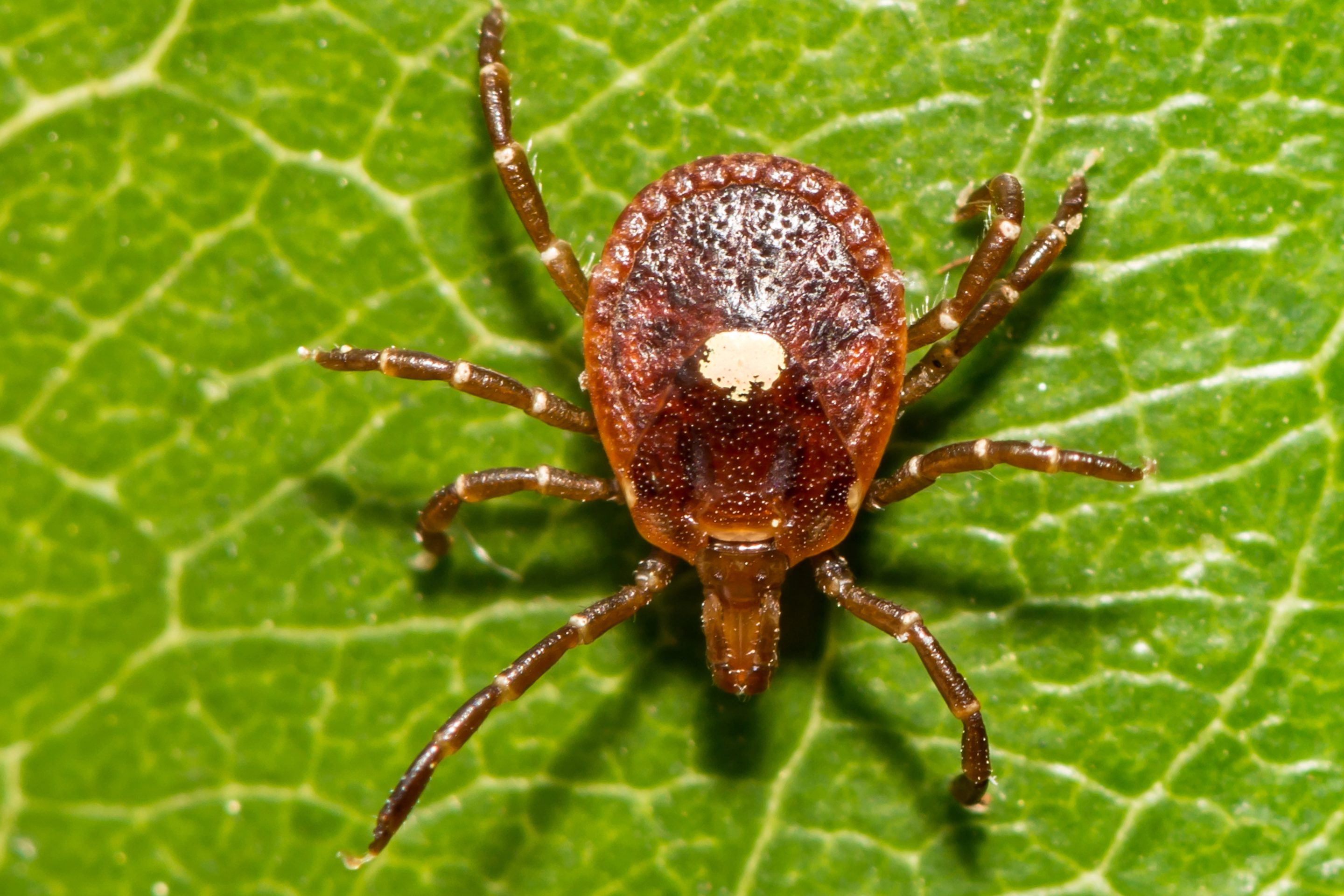
If the blacklegged tick is the quiet threat, the Lone Star tick is the aggressive one. Unlike passive ticks in North Carolina that simply wait for a host to pass by, Lone Star ticks actively hunt, sensing carbon dioxide and movement and moving toward potential hosts. Adult females are identifiable by the single silvery-white spot centered on their backs. All life stages bite humans.
Lone Star ticks in North Carolina are active from roughly March through October, making them a presence throughout the entire NC outdoor season. They transmit several serious illnesses, including ehrlichiosis, tularemia, and Southern tick-associated rash illness (STARI). Perhaps most alarmingly, a Lone Star tick bite can trigger Alpha-gal Syndrome, a serious allergy to red meat and some dairy products that can develop weeks after the bite and, in some cases, persist for years. It’s a consequence most people never anticipate from a tick encounter.
American Dog Tick
The American dog tick is the most likely species to enter your home, because it does so on your pets. Adult females prefer to feed on domestic dogs, which then bring them indoors, where they can transfer to humans. Active primarily in spring and summer, this tick is the principal carrier of Rocky Mountain spotted fever, a potentially fatal illness if left untreated, as well as tularemia and tick paralysis.
Homeowners with dogs who spend time outdoors in grassy or wooded areas should be especially vigilant about checking their pets after every outing during tick season.
Brown Dog Tick and Asian Longhorned Tick
Two additional species round out the common ticks in North Carolina. The brown dog tick, while primarily a concern for dog owners, can transmit Rocky Mountain spotted fever and complete its entire life cycle indoors, making it one of the few tick species capable of establishing a true indoor infestation. The Asian longhorned tick, a more recently introduced invasive species, has been documented in NC and is notable for reproducing without mating, allowing populations to grow rapidly.
Ticks in North Carolina: Where They Hide and How You Encounter Them
Understanding tick behavior goes a long way toward avoiding bites in the first place. Ticks don’t jump or fly; they practice a behavior called “questing,” clinging to the tips of grasses, shrubs, and low vegetation while extending their front legs outward, waiting to grab onto a passing host. They’re drawn to movement, body heat, and the carbon dioxide exhaled by animals and people.
Where Ticks Prefer to Live on Your Property
Ticks in North Carolina aren’t distributed evenly across a yard; they concentrate in specific microhabitats where conditions favor their survival:
- The transition zone between mowed lawn and wooded or brushy areas is the highest-risk area on most residential properties
- Piles of leaf litter, mulch, and yard debris provide ideal shelter and moisture retention
- Tall, unmowed grass and dense ground cover offer abundant questing opportunities
- Shaded areas where moisture is retained; ticks dry out and die in direct sunlight and low humidity
- Along fence lines, stone walls, and the edges of gardens, anywhere wildlife traffic is common
How Ticks in North Carolina Find and Attach to Hosts
Once in the right habitat, ticks wait patiently, sometimes for months, for a suitable host to brush past. The Lone Star tick is an exception, actively moving toward detected hosts rather than waiting. Most species, however, rely on positioning themselves at the right height on vegetation and extending their legs to latch onto passing animals or people.
Once on a host, ticks don’t bite immediately. Their mouthparts require several hours to embed deeply enough to feed, which is part of why prompt tick checks are so effective at preventing transmission. They migrate toward warm, moist areas of the body, such as the backs of the knees, armpits, groin, scalp, the back of the neck, and behind the ears, which are the most common attachment sites. Their bites are painless by design, which is precisely what makes them so easy to miss.
How to Protect Your Family From Ticks in North Carolina
Effective tick protection operates on two levels: what you do to your person before and after going outdoors, and how you manage your property to reduce the tick population around your home.
Personal Protection
The single most effective personal protection practice is a thorough tick check after any time spent outdoors, but these additional measures significantly reduce the chance of a tick reaching your skin in the first place:
- Wear long pants and long-sleeved shirts when working in the yard, hiking, or spending time in wooded or grassy areas
- Choose light-colored clothing, which makes ticks easier to spot before they attach
- Tuck pants into socks or boots to close off common entry points
- Apply insect repellent containing at least 20% DEET to exposed skin and clothing, reapplying as directed
- When hiking or walking trails, stay in the center of the path and avoid brushing against vegetation on the edges
- After coming indoors, perform a full-body tick check, paying particular attention to the hairline, behind the ears, underarms, behind the knees, and the groin
- Wash and machine-dry outdoor clothing promptly after use
- Check pets thoroughly after every outdoor excursion, particularly dogs
Yard-Level Prevention
Because most tick exposure happens in residential settings, not deep in the woods, managing your property is just as important as personal protection measures:
- Keep grass mowed consistently short throughout tick season
- Create a buffer zone of wood chips, gravel, or mulch at least three feet wide between your lawn and any adjacent wooded or brushy areas, as ticks are reluctant to cross dry, open barriers
- Remove leaf litter, wood piles, and yard debris where ticks shelter and breed
- Keep the perimeter around your home free of dense vegetation and overgrown shrubs
- Move children’s play equipment away from yard edges and wooded borders
- Consider professional perimeter treatments from PMi for the highest level of yard-level protection
What to Do If You Find a Tick
Finding a tick attached to yourself, a child, or a pet is understandably alarming, but prompt, calm action is what matters most. Here’s the critical fact: for most tick species, disease transmission requires the tick to feed for 36 to 48 hours. A tick found and removed quickly, using proper technique, dramatically reduces your risk of illness.
How to Remove a Tick Correctly
The tweezer method is the only removal technique endorsed by the CDC, the Humane Society, and the ASPCA, and when done properly, it’s straightforward and effective:
- Stay calm and gently pull back any hair from around the tick to clearly expose the bite area
- Using fine-tipped tweezers, grasp the tick’s head as close to the skin’s surface as possible, not the body
- Pull upward with slow, steady, even pressure in a straight line; do not twist, jerk, or wiggle
- Once removed, clean the bite area thoroughly with soap and water, rubbing alcohol, or iodine
- Dispose of the tick by wrapping it tightly in tissue and placing it in a sealed receptacle, or flush it down the toilet; do not crush it
- Note the date of removal; if you’d like the species identified, seal the tick in a small bag for reference
What NOT to Do
A surprising number of people rely on folk remedies that the CDC specifically advises against, and some of these approaches can make things worse:
- Do not apply petroleum jelly, nail polish, or gasoline to the tick in hopes of suffocating it
- Do not use a heat source like a match or lighter to force the tick to detach
- Do not twist, jerk, or wiggle during removal; this can cause the mouthparts to break off and remain in the skin
- Do not crush the tick’s body, as this may spread infectious material into the bite wound
- Do not ignore an attached tick hoping it will fall off on its own; prompt removal is essential
When to See a Doctor
Monitor the bite site and your overall health closely in the weeks following tick removal. Contact your doctor promptly if you develop any of the following:
- A rash near the bite site, particularly the bull’s-eye pattern associated with Lyme disease
- Fever, chills, or headaches
- Muscle aches or flu-like symptoms
- Swollen lymph nodes
When you call, be prepared to tell your doctor when the bite occurred, how long the tick was likely attached, and where you most likely encountered it. If you saved the tick, bring it with you. Early diagnosis and treatment significantly improve outcomes for all tick-borne illnesses.
Professional Tick Control From PMi; Don’t Wait Until You Find One
Personal protection and yard maintenance go a long way, but they have limits. Ticks in North Carolina are persistent, and in areas with high deer, rodent, or wildlife activity, common throughout the Piedmont Triad and Sandhills, property-level tick pressure can be substantial enough that DIY prevention alone isn’t sufficient to fully protect your family.
What PMi’s Tick Control Service Involves
PMi’s tick control process begins the same way as all of their services: with a thorough property inspection. Experienced technicians assess the level of tick activity on your property, identify which species are present, and pinpoint the specific habitat conditions and entry points driving the problem. No two properties are identical, and PMi’s approach reflects that.
From there, a customized treatment plan is developed to target the areas of your property where ticks are most concentrated: lawn perimeters, wooded edges, brush transition zones, leaf litter areas, and other high-activity sites. Recommendations may also include landscaping adjustments, vegetation management, and pet treatment guidance to reduce tick pressure on every front simultaneously.
Why Acting Now Matters
Spring is the most important time of year to get ahead of ticks in North Carolina. Waiting until you or a family member finds a tick attached indicates that the tick population on your property is already well established and actively seeking hosts. Proactive treatment in early spring, before tick populations peak, is significantly more effective than reactive treatment after the fact.
May is Lyme Disease Awareness Month for a reason. The awareness campaign exists precisely because the window for preventing the most tick-borne illnesses is now, before peak season hits in June and July.
Serving the Triad and Sandhills
PMi proudly serves homeowners throughout Greensboro, Winston-Salem, High Point, Pinehurst, Kernersville, Asheboro, Burlington, and the surrounding Piedmont and Sandhills communities. With over 40 years of experience protecting NC families from pests of all kinds, PMi has the local knowledge and professional tools to develop a tick management strategy tailored to your specific property and situation.
Don’t wait for a close call. Contact PMi today to schedule a property inspection and develop a proactive tick-prevention plan tailored to your home and family.
Triad: 336-272-4400 Sandhills: 910-215-9700